Post image for Election advice from a medieval Italian painter.

Election advice from a medieval Italian painter.

by Bob Page on 28 September 2009

What does an Italian painter who died of bubonic plague have to say about the hundreds of municipal elections coming up in the United States on November 3rd? How does a medieval painter advise leaders on civic policy?

A friend is running for city council in Rockville, Maryland, a suburb of Washington, DC. Last week he videotaped a 4-minute campaign statement, along with nine other candidates running for the five-member council. This simple sentence from his statement reinforces a message painted in Siena in 1339: “My number one task will be what ought to be the number one task of everyone associated with Rockville’s government – the continued delivery of exceptional services to Rockville’s residents.”

Whatever else city and county governments do, that’s the basic goal.

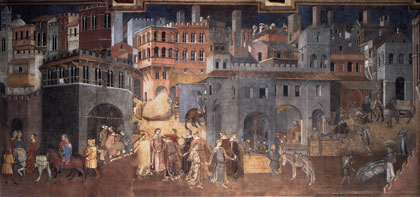
Why is Ambrogio Lorenzetti relevant in Rockville? Lorenzetti painted a huge comic book for government leaders on the walls of a council room in Siena. The room is the “Sala dei Nove,” or Room of the Nine, named for the nine leaders who met there. The Palazzo Pubblico housing the room faces Siena’s main public square, where a horse race called the Palio still takes place twice each summer.

The Lorenzetti comic book – officially, they’re called frescoes – illustrates the effects of good and bad government on city life.

In the comic book panels on good government, citizens go about their everyday business. Merchants sell cloth and tools, masons and carpenters construct a building, farmers harvest crops, professors teach students, adults watch over children at play. In the panels on bad government, greedy tyrants carry huge weapons, fields are barren and burning, city buildings decay, children go hungry, and violence reigns. It’s pretty much the 14th-century European version of Bedford Falls and Pottersville from the American movie “It’s a Wonderful Life.”

Lorenzetti seems to have had a quiet sense of humor. Quentin Skinner, a humanities professor who moved to the University of London from Cambridge just last year, wrote that Lorenzetti listed nine virtues on the frescoes to remind the nine council members of the civic qualities they were sworn to uphold: peace, faith, hope, charity, prudence, justice, temperance, fortitude and magnanimity. The central theme is that elected officials are servants with a fixed tenure, and their responsibility is to ensure services and infrastructure are in place for citizens to go about their everyday lives. Whatever else city and county governments do, that’s the basic goal.

Sometimes we forget what a healthy city looks like, and sometimes politicians forget their basic responsibilities. But Lorenzetti reminds us. Our goals are easier to achieve when we simplify and visualize them.

Italy

Share this article.
  • Digg
  • del.icio.us
  • Facebook
  • Twitter
  • StumbleUpon
  • Reddit
  • LinkedIn

{ 1 trackback }

Wrapping up the medieval Italian painter vote…
28 September 2009 at 4:46 pm

{ 0 comments… add one now }

Leave a Comment

Previous post:

Next post: