Years ago, as I expressed frustration with German grammar, a professor at Davidson College gave me a dark version of encouragement: “Look, there are 80 million people in Germany. Lots of them are really stupid, and almost all of them can speak German. It can’t be that hard.”
Never underestimate the equitable distribution of human stupidity. This is a key lesson of a 6 October lecture by Chinese-American writer Kaiser Kuo at the University of Nebraska at Lincoln.
Formerly director of digital strategy for Ogilvy’s Beijing office, Kuo has written for Time, China Economic Review, Asia Inc. and the South China Morning Post. I first met Kaiser in 2006, when he was preparing a Red Herring cover story about Lenovo.
In the online Internet world, Kuo says, Chinese people have a place for public discussion of political views for the first time in their history. Chinese government officials at all levels respect and fear this forum. Simultaneously, there is a rise in Internet access and in Chinese who can communicate with the English-speaking world. Almost 340 million Chinese have online Internet access today, up from 8 million in 1999.
“For most of the 30 years since China’s reforms began, Chinese and American civilians rarely met face-to-face in significant numbers,” Kuo says. “When encounters did take place, they were typically stage-managed events among civil, often painfully polite participants in sister city arrangements, trade delegations and cultural exchanges.
“In March 2008, in the run-up to the Olympic Games, Chinese people were curious about what the world would say about them…. But they were blindsided by negative English-language reporting. While hundreds of millions of Chinese had risen out of poverty, while the Chinese economy had grown by 10 percent annually for nearly three continuous decades, while China’s biggest cities had become forests of skyscrapers with vibrant cultural scenes, none of this was deemed newsworthy by Western news media….
“Instead, Chinese and Americans went after each other in the comment sections of news stories, blog posts, YouTube, forums and boards in an escalating people-to-people brawl that continues to this day. They fight over a litany of issues: Tibet, Taiwan, Tiananmen, trade, Internet censorship, religious freedom, Myanmar, Darfur, sanctions on Iran, carbon emissions, and so on. The first real people-to-people encounter between the world’s reigning and rising superpowers did not bode well.
“Many Chinese come away from these encounters more certain than ever that America, its government, its media, and even its people simply ‘have it in’ for China, that Americans are fearful of its rising power.… Americans, meanwhile, see confirmation of Chinese people locked in a dogmatic, nationalistic world view, perhaps the result of government-fanned flames of jingoism.
“You can see the irony, here, right? Each side seems well prepared to believe the worst about the other. But this is the Internet we’re talking about, which many of us believed would bring down barriers and usher in the death of distance, the good times of a global village. Instead, it has made us more fractured and tribal…. It’s also true within America, where nowadays you only read the political blogs and viewpoints of those who happen to be on your side of the political aisle.
“Listen only to those who are shouting the loudest on each side and one could very easily conclude that this is a war between Red Guards and rednecks.”
In the event of new international conflict on the scale of May 1999, when American bombs destroyed the Chinese embassy in Belgrade, Kuo says, we must be extremely wary. Social networks have grown enormously in 10 years. Chinese volunteer vigilantes range from reactionary “patriotic hackers” who leap unbidden to defend online national honor, to “human flesh search engines” who attempt to humiliate, bully, and trample the privacy rights of people they believe have done wrong. They often succeed.
“The next time something like Belgrade happens, involving the United States or Japan or wherever, Beijing is going to have a hell of a time trying to reign in popular nationalistic fury,” Kuo says. “Bet on it.”
In addition, global issues such as climate change require cooperation by China and the US. This includes policy change by governments and behavioral change by individuals. Unfortunately, Kuo sees obstacles.
“A growing number of young Chinese now see Western environmentalism as the latest in a long line of sticks used to bludgeon China. They’ve been browbeaten again and again by an incessant American media drumbeat about China’s polluted cities, about its coal addiction, and these young Chinese are increasingly galvanized. They’re resentful of a hypocritical United States that has gorged itself for 100 years at the trough of fossil fuel. Unless the developed West bears what the Chinese believe is a fair share of the costs, the Chinese won’t be begrudged their own turn at the trough. The number of SUVs I now see prowling the streets of Beijing, including a shocking number of Hummers, appalls me. When I ask people why they drive such conspicuously wasteful vehicles, they invariably point fingers back at the American consumer.”
To bridge this gap, Kuo prescribes three remedies for thoughtful Westerners who would like to create understanding:
1. Do not be condescending with Chinese on the Internet. They know how to access information and circumvent firewalls, using proxy servers and virtual private networks. Do not assume they are brainwashed drones. It does not support constructive dialogue.
2. Learn what Chinese people actually think when their defenses are down. The conversations taking place when it’s not believed ‘whitey’ is around are decidedly more nuanced. Westerners can read this dialogue, translated into English from Chinese, on “bridge blogs” such as ChinaGeeks, ChinaSmack, ChinaHush, and Danwei. [Another valuable resource: EastSouthWestNorth.]
3. Read a book of relevant history. China is freighted with historical baggage, and it’s not something Chinese people easily shrug off. To start, Kuo suggests “The Search for Modern China” by Jonathan Spence.
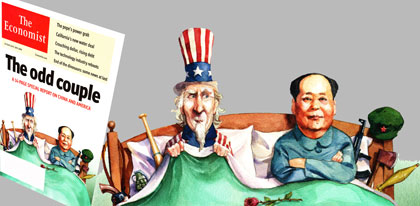
Illustration from the 24-30 October edition of The Economist, with a 14-page report on “The odd couple,” China and America.
![]()


{ 7 trackbacks }
{ 24 comments… read them below or add one }
Great breakdown of an insightful speech. Thanks to both of you!
The illustration illustrates the west’s problem. Many in the west still see China as Mao’s China.
So what remedies does he recommend for thoughtful Chinese who would like to create understanding?
Extremely thoughtful observation, and I agree that most Western observers do not recognize the enormous changes that have taken place in China since Mao, creating a dynamic, entrepreneurial climate filled with possibility. At The Economist, the illustrator’s dilemma was to select two icons with enough global recognition to personify these two countries. Uncle Sam symbolizes some of the jingoistic, nationalistic qualities described in Kaiser Kuo’s speech, as does Mao. Political cartoons are rarely known for subtlety.
Excellent question. The speech was directed to an audience of educators, students and citizens at the University of Nebraska, so Kaiser Kuo’s recommendations were designed for Westerners. Our online advantage is that we can easily collaborate in all directions, and that question creates a great question for a follow-up. Thank you.
This special section of The Economist really caught my attention. I too thought the choice of icons was striking, but a good choice to communicate to its intended western/industrialized audience. What I walked away with after reading is that global success will come from collaboration of these two powers. Collaboration occurs first through dialogue, then understanding. Understanding occurs after we experience a shift from our own culture toward the perspective of another. Fortunately, or unfortunately, as our own perspective will dictate, our national appetites have forced us toward this current state. I’m excited, not afraid, for the future.
Karyn Page
CEO, Kansas World Trade Center
Wichita
Finally people have figured it out; the Western media is misrepresenting the Chinese people. The majority of Chinese are happy with their government partially because of an unprecedented improvement in living standards and partially because of government information controls / indoctrination. The Fenqing you meet online ARE the representatives of Chinese popular sentiment, and if you refuse to talk respectfully to them, if only because of their representativeness, you’ll only polarize them more and widen the chasm between China and the rest of the world.
Bob, who says anyone HAS to recognize anything? If they get ‘hurt’ because nobody ‘recognized’ their development whose fault is that, is it a fault anyway? My goodness does everyone have to stroke the confidence of China?
Tronics question is a good one too.
Sometimes it is hard to deal with people whose first or second response to anything is “well, you don’t understand China”, but the problem is that the person saying it is the one who doesn’t understand or at least doesn’t REALLLY want YOU to understand. It is a wall they set up in their own minds. China/ese will just get more upset the more they are known to the rest of the world. This can’t be changed by us. Not everything can be way we want it to be.
But I do believe in being polite! And my post is not written in a mean spirit.
Perhaps we’d all do better if people didn’t take what’s said on the internet so seriously.
How about some pointers for Chinese netizens in dealing with Western netizens? Has Kaiser publicly addressed Chinese netizens regarding their online behavior?
I wonder if the same intelligent advice is offered to the Chinese netizens.
Make no mistake about it, a rational approach does not always work in China.
This speech was presented to a Western audience. Thank you for the suggestion to address similar recommendations for a Chinese audience.
Recognizing news is the function of news media. The question is whether significant economic development went underreported.
http://www.newyorker.com/arts/critics/books/2009/11/02/091102crbo_books_kolbert
The New Yorker reviews a book on internet echo chambers (should I get a New York Review of Books subscription instead?).
Tronic, check out Fool’s Mountain. They’ve been trying to be understanding and politic, but it’s also funny to see the fact that they haven’t been indoctrinated by American notions of PC so they make strange comments about other ethnicities or are unsurprisingly uncritical of effusive praise of their ethnic group.
Jay, regarding Chinese behavior, Kaiser Kuo is an eminence in the English China-oriented blogosphere. In the Chinese-language blogosphere, he’ll probably be perceived as just another foreigner. Look at his name; Kuo is a Wade-Giles transliteration. I don’t think he has the stature among Fenqing to make any reasonable advice.
That said, the usual advice goes for trying to convince someone else with an entrenched viewpoint: be tolerant, be patient, don’t make personal attacks, don’t heighten your counterpart’s attachments to their beliefs. Remember that your end-goal is to arrive at some sort of agreement, not to mercilessly brutalize your counterpart.
Great, however it seems to assume that:
1) A lot of the opinions you read online aren’t the result of a concerted campaign of political indoctrination by the Chinese government – anyone with any experience of the Chinese education system and media can tell you that government political indoctrination and propaganda, unchallenged by independent voices, are a definite factor in opinion forming in China.
2) ‘Western’ is synonymous with ‘American’ – the truth is that the majority of westerners in China right now are not American, even though they are often addressed as such by Chinese.
3) That people who think of China as a corrupt single-party dictatorship are somehow stuck in a time-warp – anyone with any experience of the Chinese government can tell you that that is exactly what they are.
America’s relationship with China is not one between equals. Simply put, China is an awful mess. If Americans woke up tomorrow to find that the U.S. and China had somehow switched places, we’d commit collective suicide. Sixty years after the founding of the P.R.C and thirty years after “Opening and Reform,” China still ranks just 133rd in the world in per capita GDP. In real exchange terms, China’s economy is just US$4.4 trillion, while the combined economies of the U.S. and EU measure in at more than US$33 trillion. All this talk about the China saving the world economy is complete nonsense – the Chinese will be very lucky to save just themselves. For every Chinese person who earns more than US$10,000 (~150 million) per year, there are approximately three (~400 to 500 million) who live on US$2 per day or less. The most inclusive estimates regarding the size of China’s middle class suggest that as many as 400 million Chinese have been lifted from poverty during the past thirty years -meaning that nearly a billion of their compatriots are still very poor. (Truth be told, most of China’s middle class would be considered poor by Western standards. Beijing, Shanghai, and Shenzhen are simply not representative.)
I like Kaiser and agree with some of what he says (American’s often demonstrate a disappointing ignorance regarding China). It’s true that the Western press gets China wrong more often than it should. Even so, the Chinese media’s treatment of the West – and America in particular – is not simply wrong, it’s purposefully misleading and laughably Sino-centric. One need only read a week’s worth of headlines from the Chinese version of the Global Times to understand the degree to which average Chinese are “prepared” by the Ministry of Propaganda to dislike, distrust, and disrespect the collective West. Fox News could learn much from the spin doctors of the People’s Republic. In short, China suffers from decades of poor education, patriotic indoctrination, profound and widespread xenophobia, gut wrenching poverty, the lack of speech and media freedoms, and a government that is increasingly paranoid and suspicious of the Chinese people.
Don’t fear China. Don’t envy China.
FOARP,
this article is a summary of Kaiser Kuo’s speech, which addresses most of the points you raise here. It’s worth listening to. Thank you for your observations.
Bob Page
Rebecca McKinnon of Global Voices and the University of Hong Kong is another source to look at the use of the Internet in China. She is a former CNN reporter who has now become an academic. Seen her present a couple of times when she was at Harvard Law School’s Berkman Center and last year when she came back for a visit to talk about how the Chinese navigate around online censorship.
Gmoke,
I agree completely. The link in this article on the human flesh search engines connects to Rebecca MacKinnon work on tribes of the Chinese Internet.
Bob Page
On how the internet operates in China, I recommend the article China’s Internet Paradox by MIT Tech Review at http://www.technologyreview.com/web/25032/page1/.
Aileen Jin
Webmistress of China Jobs
Thank you Aileen. Good luck with your new website. Bob
This (blog) is an American’s general observation of Chinese urban and rural culture without a political or business agneda. There are some views contrary to popular western perceptions. If interested, please stick with me, it is work in process, still being added to. I’m really enjoying the highly intellectual views in this site. Thanks for allowing me to learn about a country in which I have “dove-in” on a cultural level first.
Please enjoy: “American in China/No-Spin Blog”:
http://amerinchina.wordpress.com/2010/05/05/hello-world/
Joe,
It’s great to hear from you. There is some outstanding work being done at China Law Blog, Imagethief, The Peking Duck, Danwei and East South West North. The city where you’re living, Wuxi, is pretty much the Cooperstown of baseball in China. See http://www.mercurybrief.com/2009/11/major-league-baseball-china/
The best of luck to you on your blog!
Bob