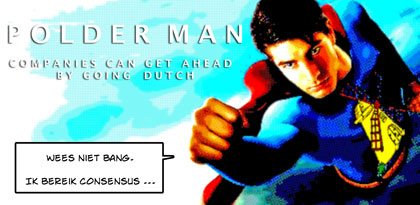
Companies get ahead by going Dutch.

The field of issues management could use a lesson from the Netherlands: the polder model.

by Bob Page on 16 November 2009

Predicting the future is not as difficult as people think. The Dutch have been doing it for 800 years. In a place where 27 percent of the land and 60 percent of the people live below sea level, everyone recognizes the consequences of failing to prepare for floods and the opportunities of being surrounded by rivers and ports.

Communicators could learn a system for turning future adversity into opportunity from these eight centuries — especially people in issues management, a field that prevents challenges from turning into crises.

Since the 1200s, when they began reclaiming almost 8,000 square kilometers of land from the North Sea, the Dutch have created 1,500 water management councils, called “polder boards.” Polders are bodies of land surrounded by dikes, and they are managed by ancient, continuously operating civic boards. These depend on building consensus and setting aside differences to solve life-threatening challenges. Predicting and managing adversity are everyday heroic qualities in the Netherlands, where classes in economics and politics teach the “polder model.”

The model suggests a direction for the evolution of issues management. Many companies and organizations deal with crises on an ad hoc basis. They create a crisis communications plan, present it to management, store it in a Powerpoint file in a forgotten subdirectory, hope they don’t have to rely on the plan, and then wing it when a crisis occurs. They react to “events,” otherwise known as “crises.”  When an issue deteriorates into an event, history shows that the company generally loses the initiative and gets stuck in the muddy land of retrenchment and recovery.

The level beyond ad hoc — issues management — is pro-active. A communicator scans the environment for current and future issues facing the company; engages and audits functional areas to include their issues; prioritizes these issues; identifies gaps between public expectation and actual company performance; interacts with external organizations, agencies, and players; and develops action plans to prevent issues from becoming events. Just as in Dutch water management, most issues are predictable. Restaurant companies know that at some point, a dining customer will encounter an unattractive foreign object in a meal. Packaged food companies know they will be attacked for trans fats, corn syrup, genetically modified organisms, or deceptive packaging. Technology companies realize that complicated designs increase the chance of product failure. Preparing for predictable situations like these prevent a company from taking on water.

But issues management is still focused on inoculation, or preventing something bad from happening. This is better than passively waiting for events to occur, but doesn’t yet recognize that the discipline of preparation creates a new set of opportunities. The Dutch maintain the best water management systems in the world because they don’t want the city of Haarlem to flood. But these same skills trained them to drain an inland sea, create Lake Yssel, and build the city of Emmeloord on a polder formerly covered by 5 meters of water.

The last four years generated substantial business momentum around the environment and sustainability, creating economic opportunities in organic food products, recycled packaging and energy conservation. But these opportunities were visible 10 years ago. Preparing for them should already have uncovered new opportunities for the world of 2020.

In the tradition of Dutch planners and students who apply the polder model in new ways,  I’ll list four components useful in issues management.

No. 1: Forecasting

A follower of the polder model creates tools and teams that scan the environment for future challenges and opportunities, prioritizes these, creates action plans, predicts the obvious future, and uses intuition and history to prepare for a cloudier, long-term future. The approach combines strategic planning with public affairs.

No. 2: Diplomacy

The polder model requires listening to the concerns of organizations, agencies and players outside the company, finding common ground, building trust, identifying resources, and forging alliances. These alliances will extend company reach from suppliers through customers. In the face of a common obstacle, the alliances may include competitors.

No. 3: Counsel

The issues management director advises company leadership regarding opportunities on the horizon, suggests opportunities that require evaluation for potential investment, and counsels calmly on short-term issues. The only crises should be ones that are impossible to predict.

No. 4: Communication

A director following the polder model communicates easily with all kinds of audiences inside and outside the company, prioritizes issues and opportunities and builds consensus for a plan of action, and then conveys a coherent, credible plan. Staffing would require one person at a corporate level, with a broad vantage point. In some cases, responsibilities for corporate sustainability could be incorporated.

The Kryptonite and the promise of polder planning.

The polder model has weaknesses. Superman’s fatal flaw was kryptonite, and two varieties for the polder model include the slow pace of consensus-building and the flattening impact of forging agreements among multiple players. One weakness of issues management is measurement, the nearly impossible task of quantifying savings from problems dodged and issues avoided. But on this problem, the polder model provides some solutions. Just as with Emmeloord, a new city built on land reclaimed from the sea, managing adversity can create measurable, revenue-generating opportunities. A food company buying crops from local farmers, for example, develops new skills to capitalize on consumer demand for locally grown products.

Applying the polder model to issues management moves companies beyond whitewashing mistakes toward a collaborative approach that inherently does the right thing for the community, economically and ethically. After a year of distress over economic conditions that may have been predictable, listening to Dutch engineers and civic planners with an 800-year track record for success sounds promising, doesn’t it?

Thanks to my Dutch colleagues Sheji Ho and Carina Van Vlerken, and to Keith Schellenberger of Lean Six Sigma Services.

Illustration with the Dutch line “Have no fear. I build consensus.” Apologies to Warner Brothers and DC Comics.

netherlands

Leave a Comment

Previous post:

Next post: