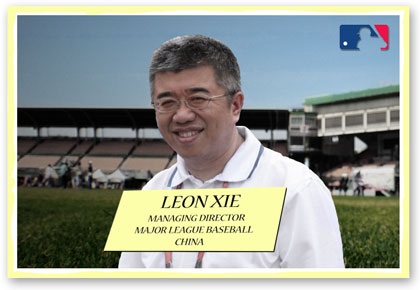
Leon Xie is managing director of Major League Baseball China.

Leon Xie creates new baseball mythology in China: If he builds it, they will come.

by Bob Page on 30 November 2009

Q1. Your first year as Managing Director for Major League Baseball China has been busy. What are you working on?

Considering the fact that the first MLB China office only opened in Beijing in 2007, we’ve made a lot of progress.

  • We opened China’s first baseball development center in Wuxi in September, where the first camp will train up to 60 of China’s top-rated 12- to 15-year-old players in the next six years.
  • We’re finishing up a five-month road show for the MLB Baseball Park interactive experience, with appearances in Shanghai, Wuxi, Guangzhou, Chengdu and Beijing, at about four venues per city.
  • In October we signed three new broadcast partners — Shenzhen TV, Jiangsu TV, and Beijing TV. Because MLB International already has relationships with Shanghai Media Group, Guangdong TV, ESPN Star Sports, and China’s leading cable sports channel — Great Sports — MLB broadcasts can now reach a potential 250 million viewers in China. That’s about 84 percent of the population of the USA, across five television networks.
  • We’ve now opened more than 80 MLB retail shops in China, about half of them in the last year.
  • And we’re supporting about 120 schools that offer baseball teams throughout China.

Q2. What other professional baseball leagues are there in China, besides MLB?

We’re building on a long baseball tradition. An American missionary started the Shanghai Baseball Club in 1863, and the game flourished for about 100 years, until the mid-1960s. More recently, the China Baseball League was founded in 2002. The CBL has seven teams: the Beijing Tigers, the Sichuan Dragons in Chengdu, the Tianjin Lions, the Guangdong Leopards in Guangzhou, the Jiangsu Hopestars in Wuxi, the Shanghai Golden Eagles, and the Henan Elephants in Zhengzhou.

Q3. The NBA is extremely popular in China. Houston Rockets center Yao Ming played a big role in building that popularity, and now there’s forward Yi Jianlian of the New Jersey Nets. Are there rising Chinese players in MLB who are popularizing the sport?

Three Chinese players are playing in the Major League Baseball system in the United States. They’re young and in the developmental stages, so they’re not quite yet at the Yao Ming level, but they all played for the 2009 China national baseball team. They include pitcher Kai Liu and catcher Zhenwang Zhang, who started in the New York Yankees developmental organization in 2007. Ray Chang, who was born in Kansas City to Chinese parents, plays shortstop for the Altoona (Pennsylvania) Curve in the Pittsburgh Pirates organization.

Harry Kingman was born in Tianjin in 1892 to Congregationalist missionaries. On the Yankees roster in 1914, Kingman was the first major leaguer born in China. Liu and Zhang also were born in Tianjin.

Q4. Why is baseball growing in popularity in China? What characteristics of the sport resonate?

Nowadays, more than four million people across China are involved in baseball. More than 60 universities in major cities are playing baseball. Compared with other sports, baseball has six unique characteristics. It’s fun, simple, smart, fashionable, and represents fellowship and family. These make it destined for popularity with the Chinese population, especially with young people and teenagers. These are the target groups of MLB in China.

Q5. You had a huge role with Lenovo, the biggest technology company in China, when you managed operations for marketing and technology support of the company’s worldwide Olympic Games sponsorship. How is it different to work in baseball?

The global theme of the Beijing 2008 Olympic Games was “One World One Dream,” so there is no big difference essentially. The Olympic Games helped us launch a Chinese brand to the world. At the MLB, I’m finding ways to popularize a globally known sport and build the MLB brand in China. It is a privilege to have these opportunities and to earn these professional experiences.

Q6. What is the single biggest challenge for the success of baseball in China?

Compared with some other sports, baseball is still less popular in China. People have a very superficial recognition on the game, and need to be educated at all levels.

Q7. What has been the most meaningful lesson for you, personally, as you’ve managed MLB’s development in China during the last year?

china-baseball-wordsFor anyone with a cross-cultural job like mine, a big heart and efficient communications are key.

Q8. You have a young son, Qilin, who is now 5 years old. What does he like about baseball?

Qilin likes pitching a sponge ball to me, and watching me miss the hit.

Q9. You’ve spent quite a bit of time in the United States, in Houston. What was your experience with baseball there?

Most of my experience was with the Astros. Playing baseball is a delightful experience that reminds people of their childhood. Baseball stands for the affection of family members, especially between father and son.

Q10. There are so many baseball myths and legends in the United States. The poet Walt Whitman called it “the American game.” Do you consciously begin trying to create baseball myths in China, or do they just have to happen naturally?

Baseball has a long history in America. There are so many baseball myths and legends, like legendary pitcher Roger Clemens and the greatest baseball player of all time, Babe Ruth. China just started its professional league in 2002. In the Beijing 2008 Olympic Games, the Chinese baseball team won a historic victory over Chinese Taipei. This was China’s first major baseball victory in global competition. More and more Chinese players are coming up, so we believe that Chinese baseball superstars are on their way.

Q11. How does MLB build a baseball culture to China? How do you bring up 7- and 8-year-olds in T-ball, create a Little League from scratch, put baseball teams in the equivalent of Chinese high schools? It’s a task worthy of Lou Gehrig.

Lamb kebabs, "yang rou chuan," the Chinese version of hot dogs.

Lamb kebabs, "yang rou chuan," the Chinese version of hot dogs.

To build a baseball culture, we need to broaden the appeal of baseball games, increase participation, and improve the quality of play through a long-term strategic plan. We have already launched our grassroots youth baseball program PLAY BALL! in five cities across China, starting in September 2007. A baseball program is incorporated into the physical education curriculum in 120 elementary schools in Beijing, Shanghai, Tianjin, Wuxi and Guangzhou, reaching more than 100,000 students, ages 8 to 12. In the near future, baseball will be in middle school, high school and university for sure.

Q12. Sports are powerful forces for international understanding and goodwill. Baseball, in particular, has played a huge role in integration in the United States. There was Jackie Robinson, the first African-American in the Major League; Satchel Paige, who pitched for the Negro leagues and joined the Major League at age 42; and Hank Aaron, who held the career record for home runs (755) for 33 years.

Is there similar potential for Major League Baseball in China?

No doubt about it. Baseball is a great equalizer and it’s an outstanding force for international diplomacy. For example, the China Baseball League has a training partnership with the Nippon Professional Baseball in Japan, where coaches and players can train in both countries. In the past years, MLB also put great effort into helping the China team prepare for the Beijing 2008 Olympic Games.

Q13. What are the favorite MLB baseball teams and players in China? Which jerseys sell best?

Chinese fans love to watch MLB games. Among the 30 MLB clubs, the Yankees, Red Sox and Los Angeles Dodgers are the most popular. MLB has some of the best athletes in the world, such as Derek Jeter, Ichiro Suzuki and Albert Pujols, and their jerseys all sell very well here.

A 2007 MLB film on baseball in China, by Rick Widmer.

China

Share this article.
  • Digg
  • del.icio.us
  • Facebook
  • Twitter
  • StumbleUpon
  • Reddit
  • LinkedIn

{ 1 trackback }

Churbuck.com » Leon Xie is creating new baseball mythology in China: If he builds it, they will come. | The Mercury Brief
1 December 2009 at 8:56 am

{ 0 comments… add one now }

Leave a Comment

Previous post:

Next post: