Scholar Susan Shirk says modern China combines fragility and strength.

Scholar Susan Shirk: modern China combines a powerful profile with a fragile core.

by Yuan Elle Wang on 23 November 2009

Chinese President Hu Jintao appears to agree with the late American politician Tip O’Neill, a Speaker of the U.S. House of Representatives who said “All politics is local.”

Speaking recently at the University of Nebraska, China scholar Susan Shirk said continuing domestic threats exert enormous influence over the global behavior of China’s government leaders. Grasping the linkage between domestic and foreign issues is one of the keys to a better understanding of the country.

“Outside of China, the country looks so successful, so powerful as it rises economically and militarily that we see its leaders as larger than life,” Shirk said, in a 12 November lecture in Lincoln. “But I believe in their own minds, they feel like scared children, trying to stay on top of a society that has been drastically changed.”

Shirk’s American friends question use of the word “fragile” in her book, “China: Fragile Superpower,” and her Chinese friends doubt the word “superpower.” Chinese perceive their country as internally fragile, while the world sees an emerging superpower.

Political leaders in China face acute insecurity over domestic issues, Shirk says, despite an economic boom and quick recovery from the global economic crisis. Even after 35 years of economic reform, opening up China to the world created unprecedented challenges for Communist party rule. One crucial stressor is massive, historic migration and urbanization, which means the party can no longer keep track of people the way it used to.

Another stressor contributing to domestic fragility and apprehension among Chinese political leaders is the growth of Internet news distribution. Shirk pointed out that 300 million Chinese now obtain news and information over the Internet. These media organizations are no longer just state-run, and their power drives the agenda for newspapers, magazines, and broadcast television and radio. Media must distribute exciting stories that attract audiences, because they now compete with each other for audiences and profits, and they have an incentive to push the limits of government-imposed censorship.

“As a result, Chinese government can no longer keep people ignorant of what’s been said and what’s been done in Washington or Tokyo or Taipei or even in other parts of the country,” Shirk concluded.

Rampant nationalist public opinion articulated on the Internet is another important concern, Shirk says. Chinese politicians listen carefully to these opinions, creating a powerful new form of political pressure. Media take a nationalist approach to build audiences. Often, leaders feel they must take a tough stand as a result of public opinion — such as their approach to Tibet.  Shirk says the elevation of Tibet to a core issue of sovereignty, nearly equivalent to Taiwan, is a dangerous sign.

This profound Chinese nationalism is both spontaneous and manufactured, Shirk says. School textbooks manufacture it, and proud identification with national achievement generates it spontaneously.

In conclusion, Shirk advised Westerners to be aware of this internal sense of Chinese fragility. The actions and statements of Americans reverberate through Chinese domestic policy, Shirk says, and their behavior can help China act like a responsible superpower, rather than an aggressor driven by domestic predicament.

Shirk is director of the University of California’s Institute on Global Conflict and Cooperation, and teaches political science in San Diego. During the Clinton administration she served as Deputy Assistant Secretary of State, responsible for China.

Wang, a graduate student in communication at Columbia University in New York, is from Maanshan in Anhui Province.

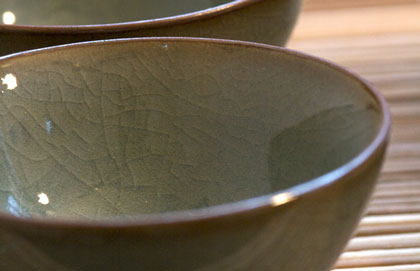
Celadon glaze inspired by China’s Song Dynasty, 960-1279. Photograph by Brent Hughes.

China

Share this article.
  • Digg
  • del.icio.us
  • Facebook
  • Twitter
  • StumbleUpon
  • Reddit
  • LinkedIn

{ 1 comment… read it below or add one }

1 Inst 22 December 2009 at 2:02 am

I like the ceramic cracks, because it’s all backwards. It’s the glaze on the ceramic that has cracked, not the ceramic itself. It suggests that China’s profile is fragile, whereas China’s core is intact.

Not that I can or am qualified to disagree with Professor Shirk.

Leave a Comment

Previous post:

Next post: