A television commercial that captures universal human needs and inspires people worldwide is a rare thing, but Nike succeeds with a spot broadcast during the Vancouver Olympic Games. Called the Human Chain, it succeeds partly by raising so many questions.
How does a company magnetically attract the enthusiasm and goodwill of the entire planet? Who is responsible for this 60-second-long, 2,000-year-old message of perseverance?
The commercial depicts about a dozen athletes practicing their sport, representing multiple demographic groups and geographies. It opens with South African runner Oscar Pistorius and includes Russian tennis player Maria Sharapova and Argentinian soccer player Sergio Kun Agüero of Atlético Madrid. Most of the athletes are North Americans: football player LaDanian Tomlinson, mixed martial artist Quinton Rampage Jackson, BMX cyclist Mike Spinner, cyclist Lance Armstrong, basketball player Deron Williams, and a 14-year-old black belt in karate from Davenport, Iowa, Dayna Huor.
The spot’s camera technique creates a series of images of the same athlete, representing their persistent repetitions in practice. Its soundtrack is a 2006 song called “Ali in the Jungle” by The Hours, a band from the United Kingdom. The song’s operative line is “Everybody gets knocked down, how quick are you gonna get up?” The commercial was posted on Nike’s Facebook fan page on 11 February and broadcast during Olympic Games opening ceremonies on the next day.
Searching for “Nike Human Chain” on Twitter reveals constant exclamations from people discovering the commercial for the first time. Nearly all praise Nike. Many say this is the company’s best advertisement ever. In times filled with bad economic news, “Human Chain” resonates with millions of people who need to get back up. It is pegged to an event attracting billions of viewers worldwide, bears a message consistent with the Olympics, and was designed to be distributed online. Using ancient values, it inspires viewers to join athletes in endeavours of movement, discipline and self-reward.
“Human Chain” also succeeds because it generates curiosity. Does the prominent role given to Jackson, the ultimate fighter, mean his sport has gone mainstream? Who is the director? What band is doing that music, anyway? What camera rig creates images like that? What was the advertising agency? How much time and money did Nike invest in the project? Why is Deron Williams in the ad rather than Kobe Bryant or LeBron James? Why isn’t there a baseball player? Who is the bull rider?
Nike has created similar messages of inspiration before. A 2006 interactive digital campaign called “The Chain,” for example, invited soccer players worldwide to create video showing off their skills, and then to pass the ball virtually to another player in a different country. It united players into a single global team.
Just as in sports, a TV commercial depends on a big team of clients, marketing and advertising strategists, producers, directors, cinematographers, editors, musicians, and dozens of other committed people at the top of their game. The list of credits for “Human Chain” includes long-time Nike ad agency Wieden+Kennedy in Portland, Oregon, director Brian Beletic, cinematographers David Landenberg and Matthieu Libatique, and 50 others.
In May 2009, the chief executive officer of Nike, Mark Parker, gave a commencement address at the Otis College of Art and Design in Los Angeles. He provided the graduates with 11 maxims familiar to Nike employees. This is what Parker said about number 4:
“Expect rejection. There’s a Greek philosopher named Diogenes. He used to speak to statues, begging them for money. When asked why he did this he said, ‘I want to practice accepting rejection.’ You, too, will meet rejection. You will experience failure. If you don’t, you’re not trying hard enough. But failure is temporary. Giving up is permanent. Never give up.”
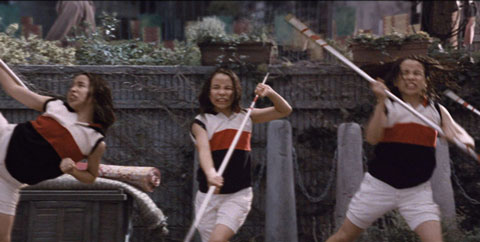
Above, Nike’s ‘Human Chain’ advertisement features 14-year-old karate black belt Dayna Huor of Davenport, Iowa.
A Nike interactive digital campaign from 2006, ‘The Chain.’