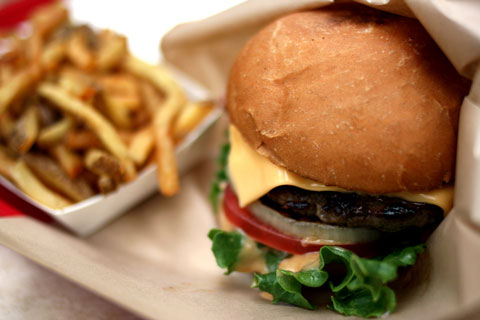
Burger in Tokyo. 2009 photograph by Christian Kadluba of Vienna.

Burgers and confetti. Social media metrics from a Chinese marketer and an Italian physicist.

by Michelle Cui Xiaoxiao on 24 May 2010
A marketing agency in Shanghai published a fascinating primer last week on a viral social media campaign in China. Rand Han, the strategy director of BA360, describes an elegant approach to measuring campaign effectiveness that recalls the work of Enrico Fermi.

BA360’s “Little Red Book” website outlines a viral campaign around a hamburger that costs 138 yuan — about $20 in the USA, or 3.5 percent of an average Chinese monthly salary. A Shanghai restaurant, Yasmine’s Steakhouse and Butcher Shop, created the burger as an inexpensive way to make the place memorable.

The campaign localizes a popular tactic from better economic times. Pricey burgers were big in 2008. Burger King publicized a $185 burger in London, and Olde Homestead steakhouse offered a Kobe beef burger in New York for $81 (now down to $41). The Four Seasons Hotel in Jakarta offered a 1 million rupee burger ($110), topped with foie gras and Portobello mushroom.  This doesn’t even include Las Vegas.

While expensive burgers are publicity stunts that actually seem to work, what’s more impressive is Han’s campaign evaluation. It boils down to two charts documenting when the news hit specific websites and discussion forums, page views, and traffic analysis. The campaign targeted Kaixin001, a Chinese version of Facebook. Along with Renren (literally, “everyone”), Kaixin (“happy”) is the most popular place for 20- to 39-year-olds to share unfiltered information with friends. Big Chinese news portals such as Sina and Sohu provide only government-approved information. Kaixin and Renren posts are created by users, making the contents and topics feel more authentic and persuasive.

Han’s second chart from Baidu Analytics (a Chinese equivalent to Google Analytics) shows how well the campaign targeted Shanghai specifically.  For example, the agency posted on Da Zhong Dian Ping Wang (an equivalent to Yelp, literally, “public comments and opinions”) twice in two weeks. Sock puppetry and astroturfing to launch buzz are common in China, with little regulation and oversight.

Companies worldwide need ways to quantify the value of social media, and measurement sometimes requires more resources than they are willing to commit. Han’s two-chart analysis offers an efficient approach.

During the Manhattan Project in 1945, the Italian physicist Enrico Fermi conceived a simple way to estimate the yield of the first nuclear explosion. He dropped strips of paper from his hand and measured how far the shock wave moved them. When we’re faced with a world where measurements don’t yet exist, maybe we’re better off to pare everything down to what we absolutely need to know.

For the record, on the West Coast of the United States, you can’t go wrong with In-N-Out Burger. Outstanding, and less than $2.50.

A marketing strategist in Chicago, Michelle Cui Xiaoxiao recently graduated with a master’s degree in integrated marketing communications from the Medill School at Northwestern University.

Above: burger in Tokyo. 2009 photograph by Christian Kadluba of Vienna, Austria.

{ 1 comment… read it below or add one }

1 Craig Merrigan 3 June 2010 at 12:05 am

My burger pick…Don’s Original in Rochester, NY. Slogan: “Where Quality Predominates.” I don’t think they have a social media strategy. But they have a really big pickle jar worth tweeting about.
Craig Merrigan
Inventive Branding

Leave a Comment

Previous post:

Next post: